

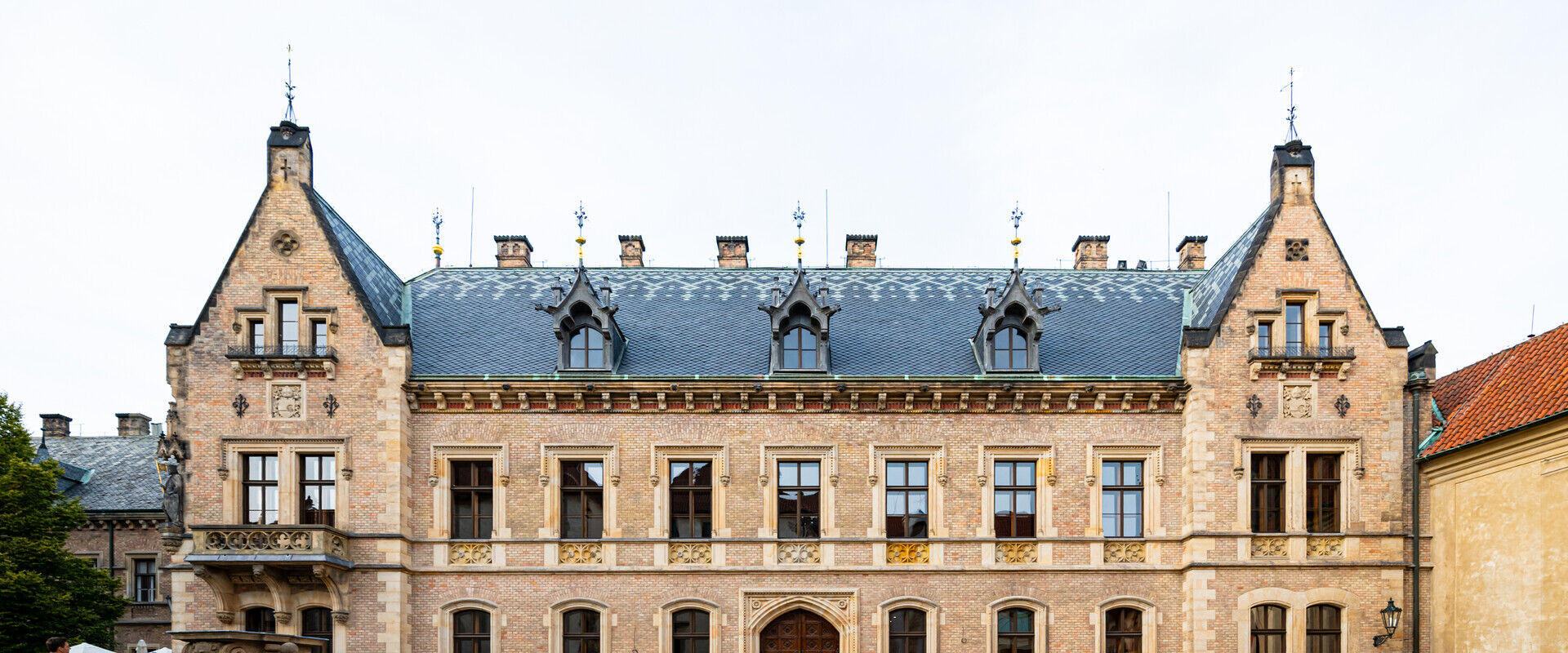
Since the beginning of the 13th century, the St. Vitus Cathedral Chapter has been responsible for electing the Bishop of Prague. Apart from its ecclesiastical tasks, the chapter has also had a cultural and educational mission. Until the establishment of Charles University in Prague, the St. Vitus Chapter administered the cathedral school. The teachers held the title of “master” and included outstanding scholars of European renown. The school at the cathedral in Prague commenced its activities immediately after establishment of the bishopric in 973.
Studies at Prague cathedral school came to an end in 1248, but were already re-established during the reign of Přemysl Otakar II and blossomed spectacularly. Around 1271, three native Czechs worked here: masters Očko and Bohumil lectured on grammar and logic, master Gregory of Valdek, later bishop of Prague, interpreted Aristotle’s writings on natural science (De natura).
In 1347 the cathedral school began to operate formally as a university with two faculties – philosophical and theological, which a year later, after the addition of two more faculties, became part of Charles University. From that moment on until now, some members of the Prague Metropolitan Chapter have held the position of professor at Charles University. Some of them were even elected to the post of rector of the university.
In 1343, the St. Vitus Chapter elected its dean, Arnošt of Pardubice, as bishop of Prague. He then went on to became the first archbishop of Prague the following year. Prague Cathedral therefore became a metropolitan church and the St. Vitus Chapter a metropolitan chapter. The status and activities of the metropolitan chapter had to be adapted to the new structure of church administration. This new situation is captured by its oldest surviving written statutes from 18 November 1350.
The Chapter of St. Vitus stayed in touch with the Holy See and administered the archdiocese through elected administrators even during the long period when the archiepiscopal see in Prague remained vacant between 1421 and 1561. Since then, the chapter has used the term “Semper fidelis” in its name, this meaning always faithful. Emperor Charles VI confirmed by means of the rescript of 13 May 1715 the right of the chapter to insert these words in its official title and ordered all authorities to use this extended title in their correspondence with the Prague Metropolitan Chapter. The chapter was granted numerous ecclesiastical and state privileges, its provost and dean held the title “First and Second Prelate of the Kingdom of Bohemia”, if they were not ordained as bishops, they were granted the title of Protonotary Apostolic by the Apostolic See, and some other members of the chapter the title of Papal Prelate.
Many members of the chapter devoted themselves to literary work. In addition to the first Czech chronicler, the chapter dean Kosmas and his contemporary, the chapter provost Mark, the most famous historians include the chapter deans Vitus, Arnošt of Pardubice and Antonín Podlaha as well as the chapter provosts Jan Ignác Dlouhoveský and Mikuláš Tomek. Some canons also contributed significantly to the development of fields other than history. Dr Karel Schuster, for example, lectured on botany at the university and wrote several treatises in this field.
The books collected by the St. Vitus Chapter were used for the personal study of its members and for its cathedral school. From the legacies left behind by individual members of the Metropolitan Chapter, a library was gradually created which is one of the oldest and most treasured historical libraries in the Czech Republic. Among the handwritten codices, the library boasts Fragmentum Evangelii s. Marci, dating all the way back to the 6th century, and the historical archive department holds the oldest preserved original parchment document from 1177. The Metropolitan Chapter also dedicated great efforts to publishing activities. In 1831, after consultation with the national revivalist J. V. Kamarýt, an educational edition “The Heritage of St. John” was founded. Later (1861), the “Heritage of St. Procopius” followed for more demanding scientific publications, and finally, the “Editiones Archivii et Bibliothecae S. F. Metropolitani capituli Pragensis” was established for publication of manuscripts and archival materials. The activity of these editions was terminated after February 1948. The library itself, or rather the collection of historical books, is currently used for specialist educational and scientific purposes.
In the 14th century, construction of the new Gothic cathedral was commenced under the supervision of the canons of the Metropolitan Chapter (who initially held the title “magister fabricae”). Their likenesses can be seen in the inner triforium of the cathedral as portrait busts. This activity was later continued by canons with the title “canon custos”. One of them, Václav Michael Pěšina, began in 1832 to establish an association for the completion of the cathedral. The gubernatorial authorities in Vienna were not in favour of this initiative, but nevertheless in 1859 the “Association for the Completion of St. Vitus Cathedral” was founded. Construction of the cathedral was finally completed in 1929 in the presence of President T. G. Masaryk and Archbishop F. Kordač. The entire construction took 585 years.
The chapter as a whole and its individual members have established various foundations with a cultural and social mission (e.g. for gifted underprivileged students). These foundations include also the “Provost and Chapter Jubilee Support Foundation” and the “Provost and Chapter Jubilee Foundation for Payment of the Cost of Worship at St. Vitus Cathedral in Prague”.
The Metropolitan Chapter fulfilled its cultural and educational mission until the middle of the last century, when it was deprived of its last remaining material resources and was hardly able to keep the remaining part of the residential buildings in working order. In 2006 and 2007, the Metropolitan Chapter took over administration of the Cathedral of St. Vitus, Wenceslas and Adalbert and other buildings. It is therefore once again fulfilling its original purpose, this being to look after the cathedral and liturgical activities. It also stores and preserves the precious St. Vitus treasure which is kept in the cathedral. The chapter is also trying to renew its cultural and educational mission. Together with Prague Castle Administration, the chapter has prepared an exhibition of part of the treasure in the Chapel of the Holy Cross. Visitors can see valuable liturgical objects and reliquaries used in various liturgical celebrations. A now traditional event is the St. Vitus Organ Evenings festival, organised under the auspices of the Archbishop of Prague in cooperation with Prague Castle Administration. The Metropolitan Chapter also runs the Prague Cathedral Choir, the Children’s Cathedral Choir and the Prague Cathedral School. As the owner of a number of cultural monuments, the chapter takes care of their condition and restoration in order to preserve the cultural heritage for future generations.
Sources and literature used:
Emler Josef (ed.), Kosmůw letopis český, in: Prameny dějin českých, Praha 1874
Eršil Jaroslav and Pražák Jiří (ed.), Archiv pražské metropolitní kapituly, I. Katalog listin a listů z doby předhusitské (- 1419), Praha 1956
Forst Vladimír et al., Lexikon české literatury, Akademia, Praha 1985
Kostílková Marie, Činnost Jednoty pro Jednoty pro dostavění chrámu sv. Víta, in: Katedrála sv. Víta, Praha 1994
Patera Adolf – Podlaha Antonín, Soupis rukopisů knihovny metropolitní kapituly pražské, I (A-E), Praha 1910
Pelcl František Martin – Dobrovský Josef (ed.), Cosmae ecclesiae Pragensis decanii Chronicon Bohemorum, in: Scriptores rerum Bohemicarum, Pragae 1783
Podlaha Antonín (ed.), Series praepositorum, decanorum, archidiaconorum aliorumque prelatorum s. metropolitanae ecclesiae Pragensis a primordiis usque ad praesentia tempora, in: Editiones archivii et bibliothecae s. f. metropolitani capituli Pragensis, Pragae 1912
Podlaha Antonín (ed.), Catalogus incunabulorum, quae in bibliotheca capituli metropolitani pragensis asservantur, in: Editiones archivii et bibliothecae s. f. metropolitani capituli Pragensis, Pragae 1926
Podlaha Antonín (ed.), Český slovník bohovědný III, Praha 1926
Podlaha Antonín, Supplementum quartum ad Seriem praepositorum, decanorum, archidiaconorum aliorumque prelatorum s. metropolitanae ecclesiae Pragensis a primordii susque ad praesentiat empora, in: Editiones archivii et bibliothecae s. f. metropolitani capituli Pragensis, Pragae 1931