
As a rule, we admire it from a greater distance, so many interesting and beautiful details remain hidden from the eyes of passers-by. We therefore bring you some detailed and unusual views of the rich stonework and stone sculpture of our cathedral.
The entire western half of the cathedral, which includes the transepts, nave, side aisles and west front, was built only in the second half of 19th century by the builder Josef Mocker and subsequently completed in 20th century by his successor Kamil Hilbert. This part of the temple is relatively homogeneous and the machine-perfect workmanship of the stone blocks is visible at first glance.
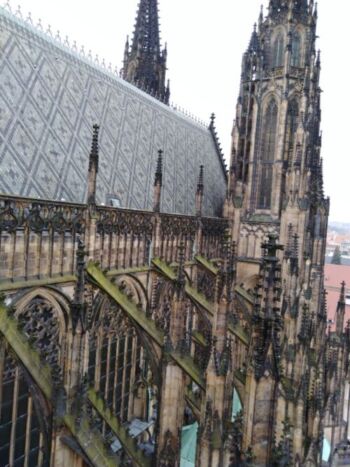
New western part of the cathedral
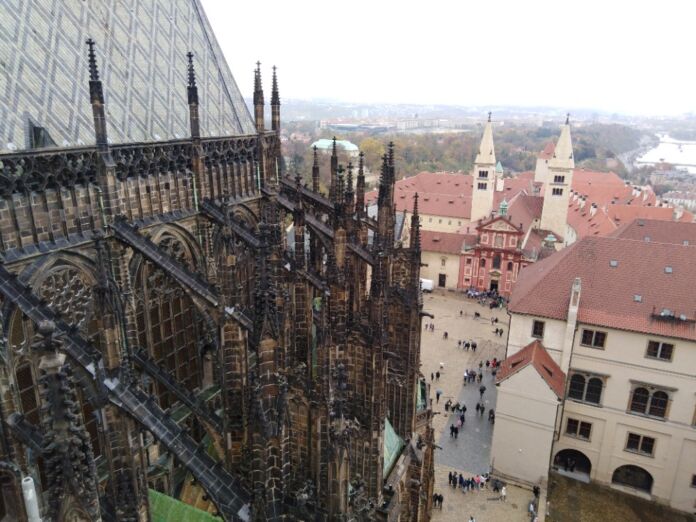
However, the eastern part is completely different – the whole choir including the chapel wreath and the support system as well as the Great South Tower. This part of the cathedral was gradually built from the middle of the 14th century. century, but throughout history it has undergone many repairs and modifications and has been exposed to all the disasters that have befallen the temple. The building history of the older half of the temple is therefore very rich and we can find traces of building modifications from all centuries of its existence.
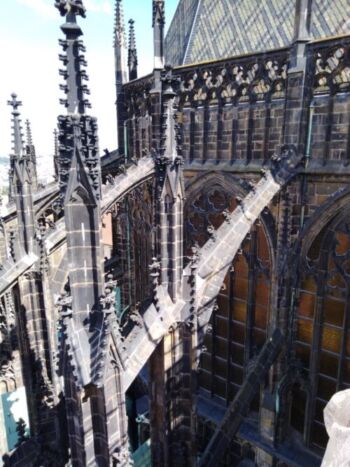
The old eastern part of the cathedral
It is very difficult for a layman to distinguish original sculptures and stone details from later copies, replicas and accessories. Experts, however, have been working on and updating and supplementing the building history survey during the repairs to the temple shell, and the temple shell has now been examined and documented in considerable detail. So we know, for example, that the original window tracery is really scarce. Not only the glass fillings and stained glass windows, but also the stone elements in the windows are relatively young, and other aged stone blocks of the support system and masonry were gradually added and replaced. The only truly original medieval window tracery can be found in the windows of the so-called “medieval” windows. The Old Treasury above the Old Sacristy.
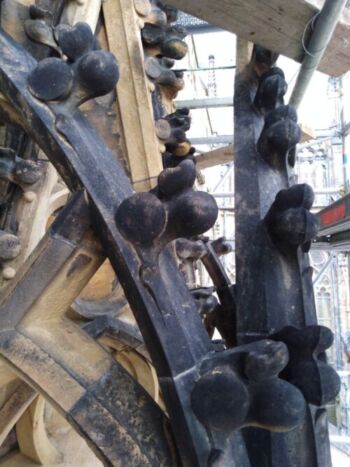
Stone-sculpture decoration
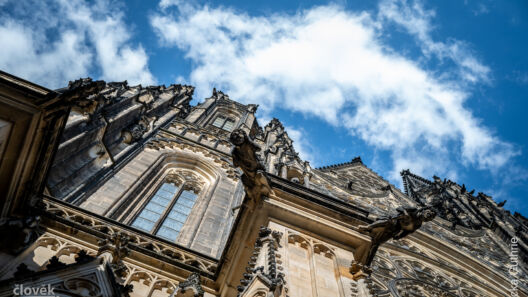
The same applies to the legendary gargoyles in the form of various animals and monsters, of which we can count dozens or rather hundreds in the various height levels of the temple. Only a few of them have survived from the Gothic period, most sources mention only four. Most of the gargoyles, even on the Gothic choir of the cathedral, were installed in the 19th century. century.
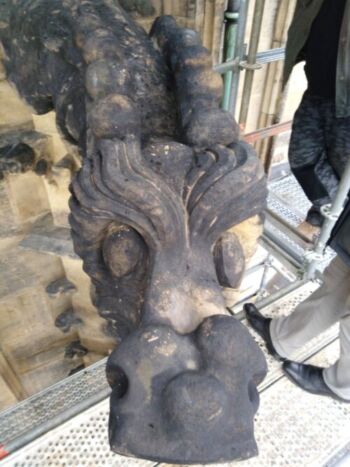
The gargoyle
On the cathedral’s cloak we can still find visible traces of the devastating fire of 1541, to which practically the entire left bank of Prague fell victim and the Prague Castle and the cathedral itself were severely damaged. The flames that engulfed the roofs of the chapels and the choir gallery affected the sandstone with such heat that it turned red. A silent witness of this fire is the mascot on the inside of the buttress above the Old Sacristy, whose photo can be seen here, but it can only be seen live from the scaffolding.
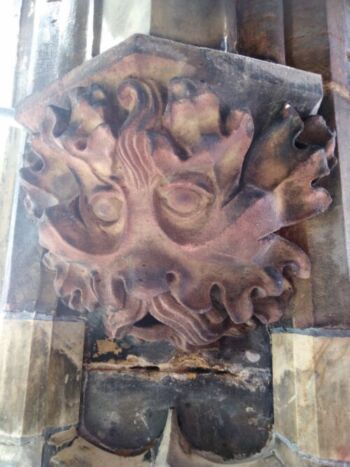
A red-faced mascot after the cathedral fire
The Prussian bombardment of Prague after the Battle of Sterbohol in 1757, where the troops of Prussian King Frederick the Great crushed the army of Maria Theresa, had far-reaching consequences. This massive clash, in which 30,000 soldiers fell, was followed by the largest military attack on Prague in history. The Prussian king’s goal was the destruction of the city. As many as 22,000 cannonballs and incendiary grenades were to be fired towards our cathedral alone, one of which set fire to the large Renaissance organ of Ferdinand, which burned down without a trace, and the first two arches of the choir were also seriously damaged by the fire. The Prussian artillery shelled Prague from the northern direction, therefore the cloak on the northern side of the church was damaged considerably, most of the small and fragile stone elements were destroyed and had to be replenished and replaced. Traces of Prussian shells on the north side of the choir are still identifiable. On the other hand, the southern part of the choir was not directly exposed to this shelling, which is why much more of the original stone elements and paneling have been preserved.
Author of text and photos: Ing. Ondřej Stříteský