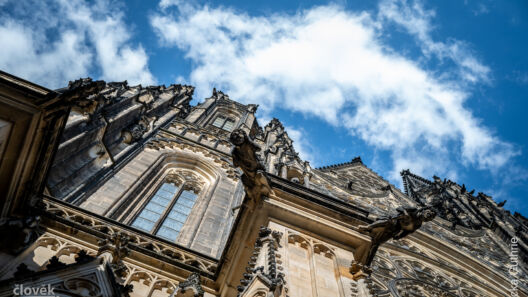

The devastating fire that ravaged the left bank part of Prague in 1541 also affected our cathedral in its entirety, of which practically only the burnt-out torso of the choir and the Great South Tower remains.
Although King Ferdinand was very keen to complete the construction of the cathedral, as records from 1537 and 1538 show, the fire marked a major turning point.
All further efforts by the Metropolitan Chapter and King Ferdinand were directed towards saving what was left of the imposing church.
In spite of numerous attempts and several structural modifications, the torso of the church, consisting only of its choir, choir gallery, chapel wreath and the unfinished Great South Tower, remained preserved until the Second World War.
It was not completed until the mid-19th century. century.
The choir and organ were not spared during the fire. According to an eyewitness, the well-known chronicler and our canon Václav Hájek from Libočany, “..The chamber in which the astronomical clock was in the church, when it caught fire, it burned upwards until the fire came under the rafters of the clergy, who were in the choir, and they fell down with their gilded caps… And through the lattices of the cellar the fire fell through the holes, and set fire to the organ, which all fell to the ground and burned; and from thence the stools were set on fire, which were of maple and oak, and the paintings of excellent workmanship, and the excellent pulpits, all were burned..”
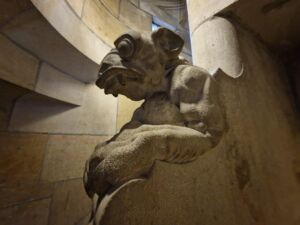
Decoration of the spiral staircase to the organ
The construction of the new music chancel took place between 1557 and 1561 and was carried out in the Renaissance style. It was designed by the builder Bonifác Wohlmut, whose design was preferred by King Ferdinand to that of the Italian architect Giovanni de Campione. Boniface Wohlmut’s design appealed to the king and was praised as “very artful, graceful and suitable for a church”. It was, however, a highly innovative undertaking. The western part of the hitherto stylistically pure Gothic choir was suddenly closed off by a distinctive Renaissance structure of ancient appearance with two rows of arcades and columns with Ionic capitals. And so it remained until the first half of the 20th century. It was only after the completion of the Neo-Gothic addition to the cathedral, which more than doubled its built-up area, that the Wohlmut cloister was dismantled by the last cathedral builder, Kamil Hilbert, around 1926. This action brought together the interior of the Gothic choir and the neo-Gothic addition of the triple nave and transept. It is remarkable that the interior of the cathedral has only existed in its present form and impressive size with the characteristic rosette window on the west for 98 years. The original form of the choir, topped on the west side by a Renaissance cloister, is still captured in several black and white photographs, which you can see in this article. Also worthy of note is a historic black and white photograph showing the view through the chancel rail into the choir to the high altar. It was here that Jan Neruda placed the plot of one of his Lesser Town short stories entitled “St. Wenceslas Mass.”
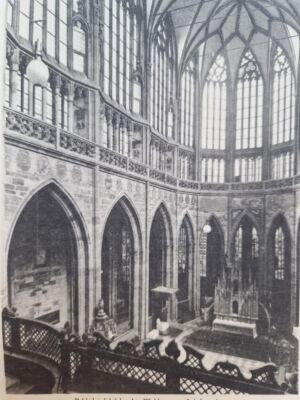
Original view from the chancel into the old part of the cathedral
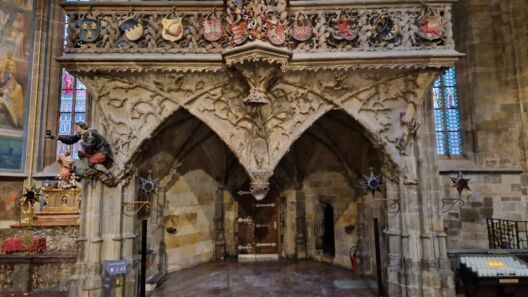
However, Kamil Hilbert preserved the Renaissance chancel for future generations and rebuilt it in a slightly altered form in the northern part of the transept, where it can still be admired today.
Although the new western end of the greatly enlarged cathedral was closed by a neo-Gothic music chancel, the project for a large organ for the cathedral, which will be placed here, has only now been realised, and Wohlmut’s Renaissance chancel, moved by Hilbert to the side of the cathedral, still serves its original purpose, and it is from this chancel that the organ, choir and orchestra can still be heard at services.
In the ground floor part of the chancel, which originally formed the entrance to the church on its west side, the choir chapel was built, which today houses the main sanctuary of the cathedral and is used for weekday morning Mass.
It is in the choir chapel that today we can admire the vaulted ceiling covered with a network of Gothic ribs, under which another layer of loose ribs is suspended in a special way.
The original location of the chancel in the western part of the choir is still reminded by two sharply cut fragments of Renaissance stone profiles, which can be seen above the pulpit and the Baroque tombstone of Leopold Šlik in the vicinity of St. Wenceslas Chapel.
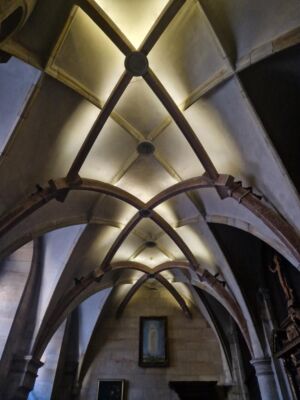
Vaulted vault with Gothic ribs in the choir chapel
While the chancel itself has been preserved in its original form, except for a few details, more organs have been built on it in the course of almost 500 years.
The original so-called.
Ferdinand’s organ, part of which can be seen at the tomb of St.
John of Nepomuk in a woodcut by Kaspar Bechteler, depicting the filling of the cathedral by Calvinists in 1619, was completely burnt down during the Prussian bombardment of Prague in 1757.
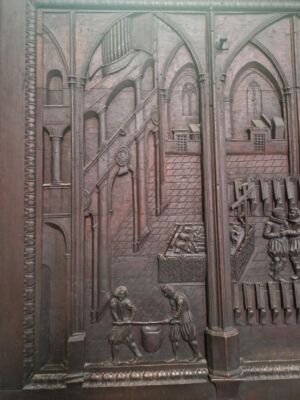
Woodcarving by Kašpar Bechteler with part of the original organ
At that time, the Prussian army, led by King Frederick the Great himself, launched the largest military attack on Prague in history and showered the entire city with cannonballs and incendiary grenades.
One of them landed on the 3rd.
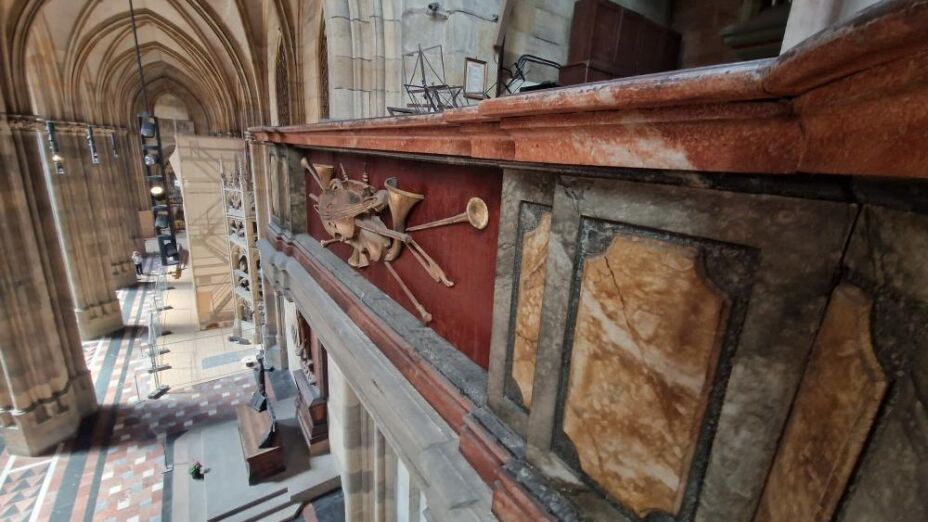
The majestic organ, reputedly the largest in the world at the time, was left with only a few drops of tin embedded in the railing of the music choir and extensive damage caused by the heat from the burning instrument on the two arched bays of the high choir.
Kamil Hilbert had to repair these vaults in the 20th century. century and as a result of the static disruption of the structures, the upper row of iron bars had to be inserted under the vaults of the choir.
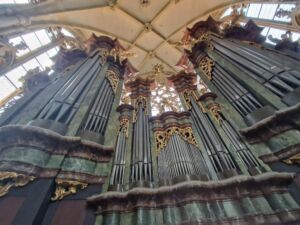
Part of the Baroque organ by Antonín Gartner
On the site of the burnt Renaissance instrument, the organ builder Antonín Gartner of Tachov built a Baroque instrument in 1762, which remained functional practically until the end of the 19th century. century and it was one of the largest baroque organs in the Czech territory. However, they did not survive the completion of the cathedral and the relocation of Wohlmut’s chancel to the northern part of the transept, because most of its parts were literally stolen. In 1929 it was on 2. on the floor of the chancel, only the prospectus part of it was assembled, which still serves as a backdrop.
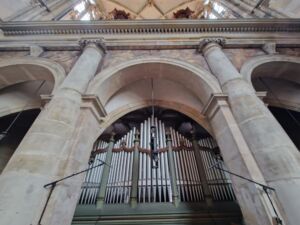
Contemporary organ by Josef Mölzer
The current working instrument is located on the 1st floor of the chancel and is a three-manual romantic organ built by Josef Mölzer, an organ builder from Kutná Hora, who changed his name to “Melzer” during the First Republic. The organ was originally supposed to be completed in the year of the St. Wenceslas Millennium, when the completed cathedral was consecrated, but it was not actually completed until 1930. However, we will bring you more details about our organ in future articles.
Historical photos: the Library of the Prague Metropolitan Chapter
Text and other photos by Ing. Ondřej Stříteský