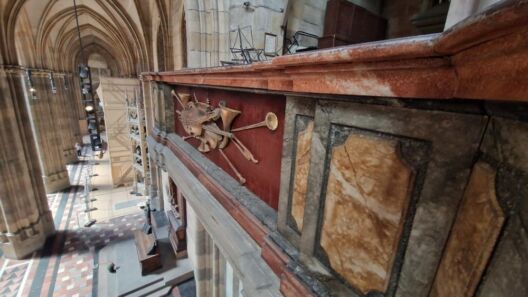


In Baroque churches, on the other hand, it is usually canopied and glazed. Access to the oratory is often via a covered brick bridge connecting the church with the adjacent palace or castle. This allowed the nobleman and his family to come to the service in all weathers from his residence and participate in the liturgy in private. Our cathedral is no exception, built in the middle of the seat of the Czech kings, where it also served as the main castle church. Not only this architecturally unique Royal Oratory has been preserved in the cathedral to this day, but also the aforementioned covered bridge connecting the cathedral with the Old Royal Palace of Prague Castle. The Royal Oratory, built in its present form at the end of the 15th century. century (1490-1493), will attract you especially with its unusual and unique in the cathedral design of stone carving, which resembles variously twisted chopped bundled branches tied with ropes, possibly polychromed in the past.
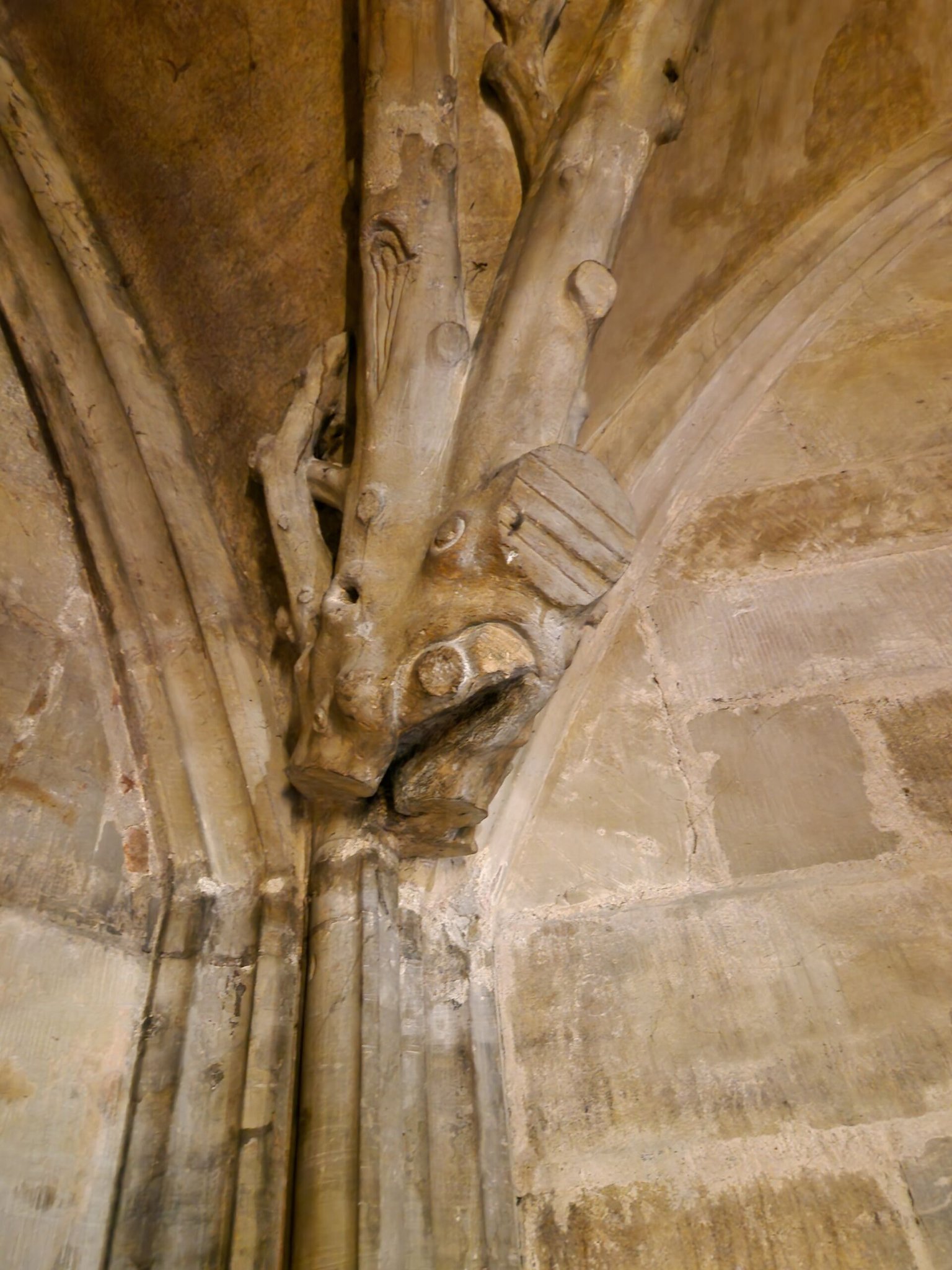
Sculptural decoration
The authorship of the oratory is not known for sure, it is most often attributed to the late medieval builder Benedikt Rejt, but in the literature we can also find claims that the author of the oratory is the stonemason and builder Hans Spiess, who, however, collaborated with Benedikt Rejt. However, there is no doubt about the commissioner of this work, King Vladislav II. Jagiellonian, whose initials (W) can be seen on the armorial shield, which is part of the hanging bolt in the central part of the oratory under the bay window. Also the signs on the railing of the oratory belong to the countries where this ruler ruled or claimed to rule. On the central bay window we can see the emblem of the Kingdom of Hungary and the Kingdom of Bohemia. On the left, from the centre to the edge, we see the emblems of the Kingdom of Poland, Slavonia, Upper Lusatia and Dalmatia. On the right are the arms of the Margrave of Moravia, the Duchy of Luxembourg, the Duchy of Silesia and Lower Lusatia. However, the walls and the vault above the oratory are among the oldest parts of the cathedral, built by its first builder Matthias of Arras. The oratory is actually set into the space that is part of the Arras wreath of chapels around the choir. Emperor Ferdinand II. had a wooden glazed box built into the oratory in 1630, which was later extended as a pavilion-type extension over the neighbouring chapels.
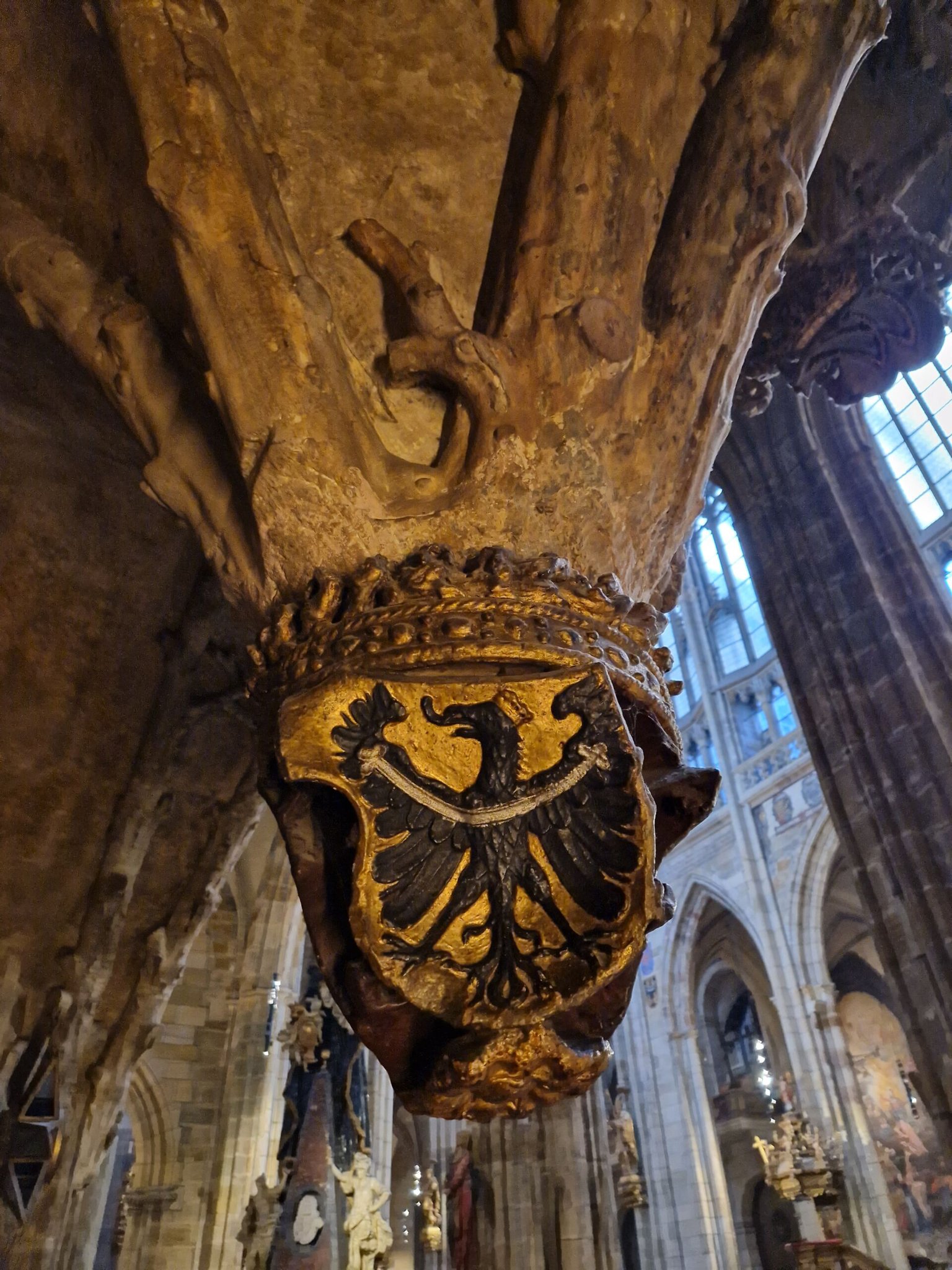
Coats of arms on a hanging bolt
Extensions above the chapels on the right from the oratory to the chapel of St. Václav were removed during the winter of 1868-1869. Later, Josef Mocker built a wooden neo-Gothic imperial box, but it was removed in 1936 and since then the oratory has remained in the form we know it today. Mocker’s Imperial Lodge was donated to the Brno Episcopal Consistory, which expressed interest in it. The attentive viewer will not miss the fact that the left part of the oratory railing is of a different and darker colour than the light grey central bay window and the railing on the right side. This is also due to a different material solution. While the bay window and the right part of the railing are original stone, the left part was added again in 1878 and was made of wood. The stone railing was damaged by a large fire in the spring of 1541, when the entire left bank of Prague burnt down and the Prague Castle and the cathedral were also damaged, the western part of the cathedral and the north tower even collapsed completely and the choir was also largely affected. This is proved by the records of our canon and famous Czech chronicler Václav Hájek from Libočany, who described the cathedral fire in great detail. He writes literally this about the royal oratory: “The royal stone pavilion, made with excellent stone work, on which it is customary for His Grace the King and Her Grace the Queen to dwell, could not remain before the fire, nor could the little world, which was on the pavilion was burnt in a strange manner, and from the fire of the railing or of the railing on which it was customary to lean, it burst, so that the stones began from the middle or from the royal ascent on the right hand to the tomb of St. Vitus was falling on the ground. Otherwise, the cellar of the lower and upper pavilion remained in its entirety.”
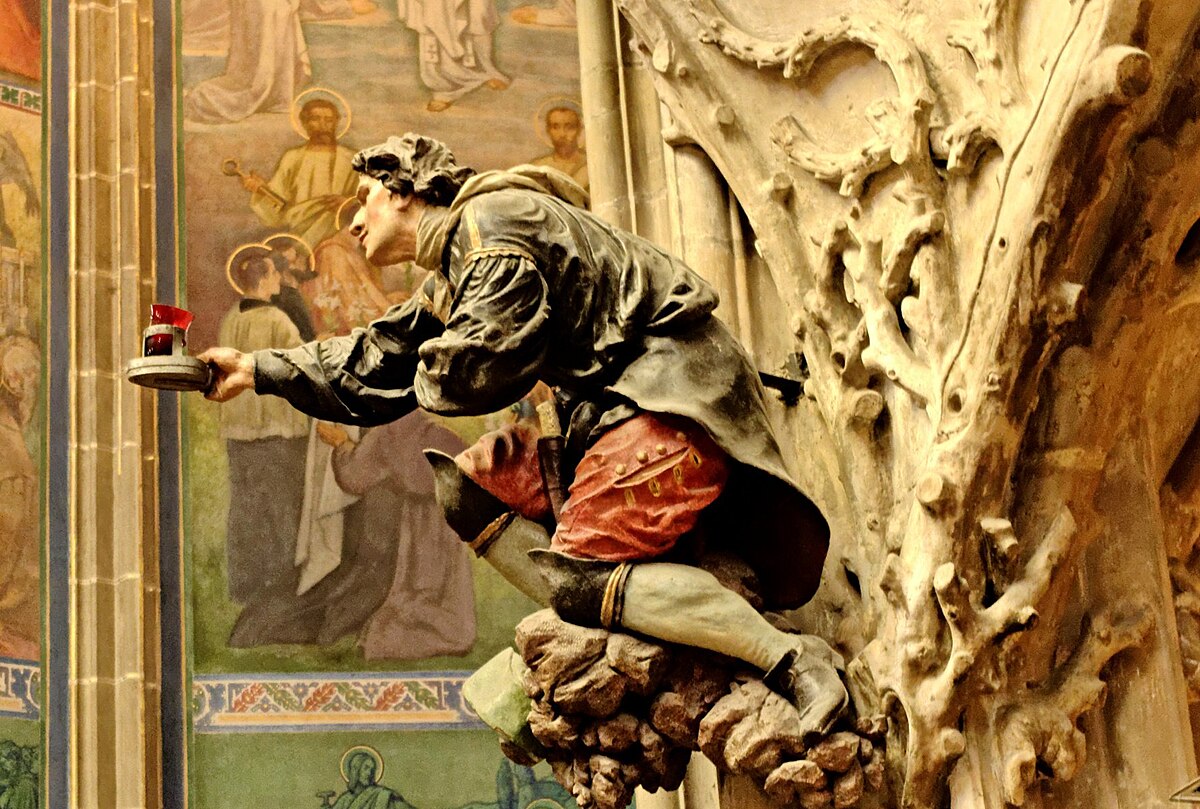
Statue of a miner
The replica of the destroyed part of the railing was made as a wooden one, probably for static reasons, so that the structure previously damaged by the fire would not be unnecessarily stressed. However, the oratory is not open to the public. Although there is a separate staircase leading up to it from the cathedral, it is usually only accessible from the Old Royal Palace.
Author. Ondřej Stříteský